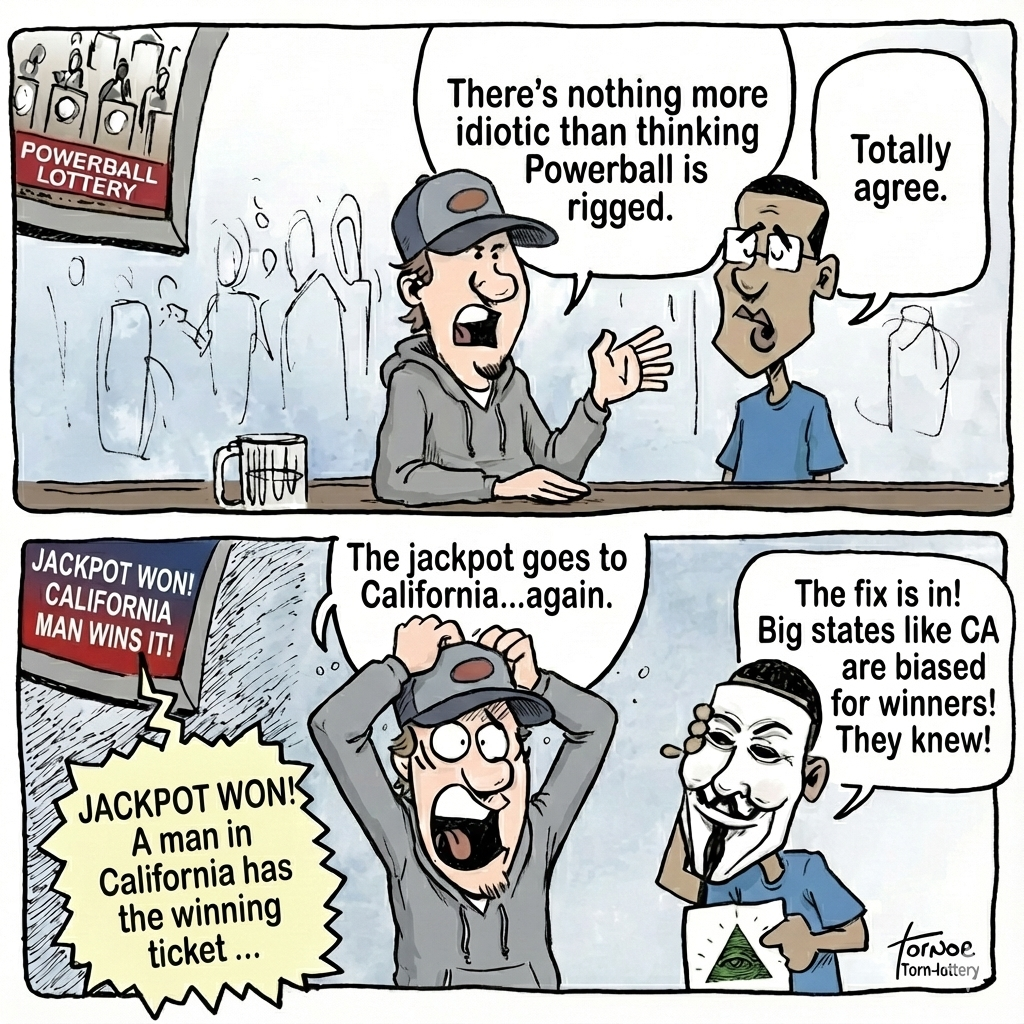
Is The Lottery Rigged or Truly Random?
Editor’s note: We have revised some of the statistically inaccurate “lottery rigged” claims made in previous versions of the post thanks to the invaluable insights of the reddit community in r/AskStatistics. We are committed to transparency and will continuously refine our analysis based on new draw data and valuable feedback from the data science and statistics communities. Our goal is to provide the most robust and accurate audit possible.
When people ask whether the lottery is “rigged,” they’re rarely asking a purely mathematical question.
They’re reacting to something that feels wrong.
Long losing streaks. Rare winners. The same numbers showing up again and again. A system run by governments that already collect taxes.
Seeing thing from the player’s perspective, suspicion and skepticism isn’t irrational – it’s natural and human. But “rigged” is a strong claim. And strong claims require careful definitions, testable hypotheses, and a clear understanding of what randomness actually looks like in the real world.
This article separates intuition from evidence and explains how lottery fairness can be evaluated responsibly, without myths, false promises, or hand-waving.
Why the Lottery Feels Rigged
Before touching any statistics, it’s worth acknowledging why suspicion is so common.
1. Randomness is emotionally uncomfortable
True randomness produces:
- Long droughts
- Clusters and streaks
- Uneven short-term outcomes
Our brains expect “fair” to mean even, but randomness doesn’t work that way.
2. Losses are constant; wins are rare
Millions of losing tickets create a powerful narrative of futility. A handful of winners doesn’t balance that feeling — especially when you’re not one of them.
3. Humans are pattern-seeking by nature
Seeing the same number twice feels meaningful. Seeing it five times feels suspicious. In reality, repetition is expected in random processes.
4. Distrust spills over
Because lotteries are government-run, skepticism about institutions often gets projected onto the draw itself — even though those are separate questions.
None of this means the lottery is rigged. It explains why the suspicion persists.
What People Mean When They Say “Lottery Rigged”
When players say a lottery is “rigged,” they are rarely referring to a single idea.
In practice, the “lottery rigged” claim usually falls into one of three very different categories — only one of which is purely statistical.
Understanding this distinction matters.
1. “The Numbers Are Biased or Manipulated” (Statistical Rigging)
This is the version that can be tested with data.
It implies that:
- Some numbers appear more or less often than they should
- Certain patterns occur too frequently
- One component (such as a bonus ball) behaves differently
- Outcomes depend on timing (days, dates, or locations)
These claims are measurable. Lucky Picks uses a formal statistical audit framework to do that, called the Lottery Fairness Score.
If such biases exist and persist across large samples, The Fairness Score can detect them.
It doesn’t predict numbers or promise wins. It evaluates whether a lottery’s draw history behaves like a fair random process.
2. “The Results Are Decided After the Fact”
This belief takes a different form:
- Numbers are allegedly generated after ticket sales close
- Results are adjusted to avoid winners
- Or outcomes are engineered so that wins favor specific states or jurisdictions
This is not a statistical claim — it is a claim about process integrity and governance.
Statistics alone cannot prove or disprove this scenario.
What can address it instead:
- Independent draw procedures
- Third-party auditing firms
- Live broadcasts and physical draw records
- Regulatory oversight
- Consistent documentation across decades
A fairness audit assumes published results are genuine.
If the results themselves were fabricated, no statistical method could reliably detect that.
That limitation is important to state openly.
3. “No One Actually Wins — It’s All a Hoax”
This is the most extreme interpretation of “rigged,” and it cannot be answered with probability theory.
It is addressed instead through:
- Verified public winner records
- Court cases and prize claims
- Independent journalism
- Tax filings and financial disclosures
- Long-running historical evidence across jurisdictions
In other words, this is an evidentiary question, not a mathematical one.
A statistical audit does not attempt to prove that winners exist — it evaluates whether the published draw data behaves like a fair random process.
Verifying “Lottery Rigged” Claims
What CAN be tested statistically:
- Persistent frequency bias beyond chance
- Pattern anomalies that survive large samples
- Temporal effects (day, jackpot phase, calendar)
- Component-level deviations (main vs bonus)
These claims are testable using historical draw data. The Lottery Fairness Score formalizes these ideas into a repeatable audit.
What CANNOT be proven statistically:
- Results altered after the draw
- Collusion between agencies
- Software manipulation claims
- “They decide when someone wins”
These are governance and transparency questions, not statistical ones.
What if bias were detected?
If the Fairness Score is low, or a statistical anomaly is detected, the first step is to stay grounded about what that finding represents.
In most real-world audits, detected deviations are small, unstable, or temporary.
They often reflect normal statistical noise rather than persistent, exploitable flaws—especially when effect sizes are small or deviations regress toward the mean.
That said, a low Fairness Score is not meaningless.
It does not prove a lottery is “rigged,” but it does indicate that the observed results would be unlikely if the system were behaving as a perfectly random process. That alone is a valid reason for increased scrutiny.
At that point, players face a small number of concrete choices:
A. Continue playing, accepting uncertainty
You may decide the anomaly is too minor or unstable to change your behavior, and continue playing as before.
B. Reduce or stop play due to detected anomalies
You may decide that any unexplained deviation—however small—is enough to no longer justify participation.
Some readers will naturally consider a third option: attempting to exploit the detected deviation.
We can’t ethically recommend using detected bias as a way to “win” the lottery.
Any detected deviation is retrospective, not predictive, and there is no guarantee it will persist in future draws.
If such a deviation were to continue, it could slightly alter the probabilities of certain types of number combinations—much like buying an extra ticket slightly improves your odds. These changes are mathematically real, but extremely small relative to the size of the lottery’s combinatorial space, and they do not create a reliable or repeatable advantage.
Treating detected bias as a reason to favor certain numbers is therefore best understood as a play style choice, similar to playing “hot” numbers: a personal preference informed by past data, not a validated strategy for improving outcomes.
The Fairness Score exists to help players decide whether to participate in a lottery with confidence—not how to play or how to win.
So — Is the Lottery Rigged?
In most major lotteries audited using modern statistical methods, the answer is:
There is no statistical evidence of systemic bias in the draw process.
That does not make the lottery generous, profitable, or kind.
It simply makes it generally unbiased.
When bias manifest, it’s typically not a smoking gun or an exploitable flaw. Especially if it persists for months, it should be a valid reason to pause or reduce play.
Both a fair or a biased lottery can be a losing game on average — and usually is.
Always consider this context, and play responsibly.
Where to Go Next
If you want to see how this framework applies to real lotteries:
- Learn how the Fairness Score is calculated
- Review full research audit reports for individual lotteries
- Understand what fairness means — and what it doesn’t — before choosing how (or whether) to play
This isn’t about prediction.
It’s about clarity.
One response to “Is The Lottery Rigged or Truly Random?”
Hoping it brings me luck.