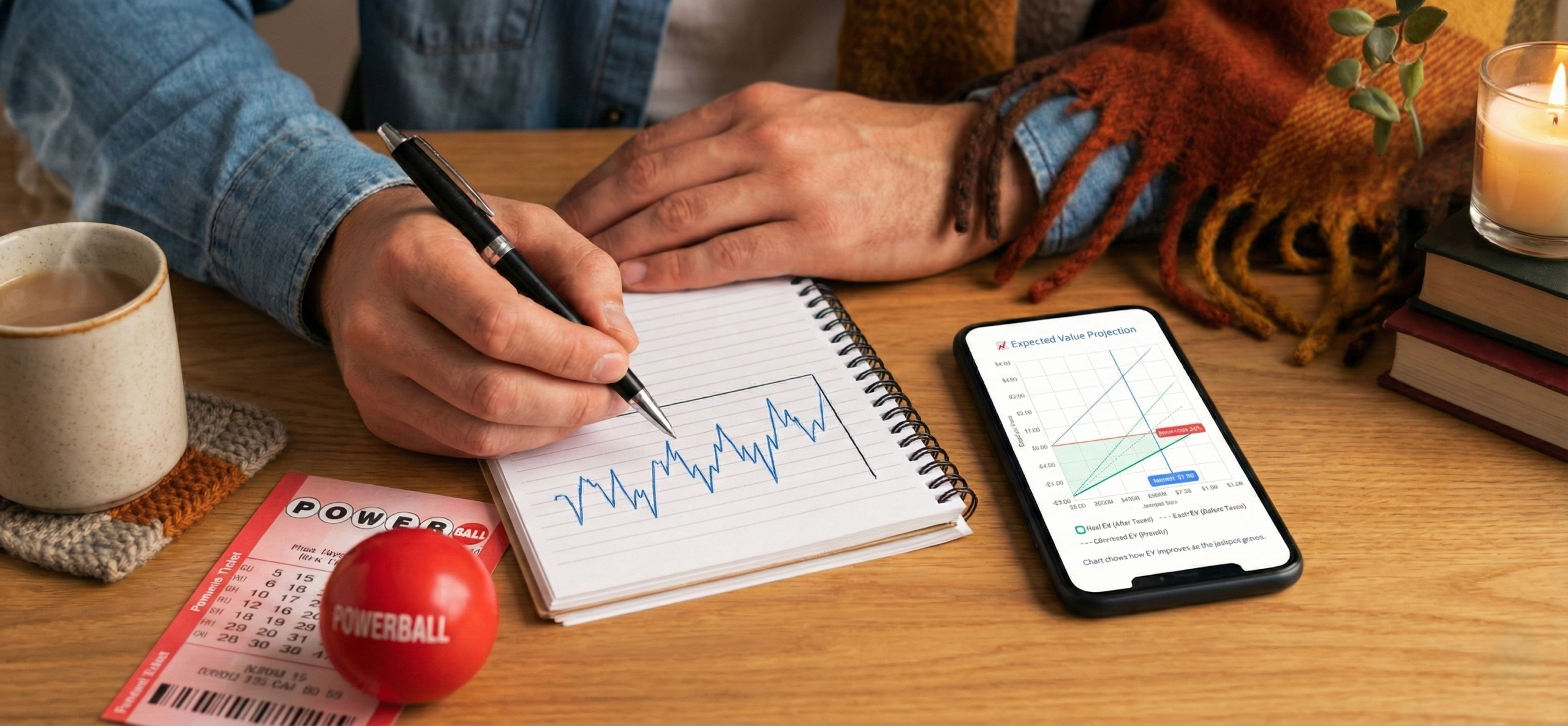
🎟️ How to Win Powerball: A Practical, Evidence-Based Guide to Playing Smart
Winning Powerball is astronomically unlikely, and nothing you do can change that fundamental fact.
Most “How to Win Powerball” guides misrepresents the math or try to sell you a secret system to beat the odds, often relying on misinformation.
This guide is here to set the record straight.
We want to help you cut through the noise and avoid the misleading advice found elsewhere. We respect that people play with a mix of hope, ritual, and imagination. We are here to help you navigate what, when and how you should play with clarity.
This is not a “way to cheat the system” guide, just a practical, no-nonsense guide to play smarter, by making more conscious choices about:
- what really affects your odds,
- what really affects your payout,
- what’s myth vs. reality,
- and how to enjoy the game responsibly and intentionally.
Let’s get into it.
Table of Contents
🔍 What Are the Real Odds of Winning Powerball?
Your chance of winning the Powerball jackpot with one ticket is:
1 in 292,201,338
≈ the chance of flipping heads 28 times in a row
≈ the chance of picking 1 second out of 9 years
Because these odds are daunting, an entire industry of “gurus” and “exclusive clubs” has sprung up to sell you solutions.
Legions of prominent websites, books or software are claiming that the use of specific “systems” can help improve these odds.
You may have seen marketing claims such as:
- “Based on decades of research by a legendary expert…”
- “Guards against the agonizing experience of missing by one number…”
- “Insanely powerful trackers that spot daily trends…”
These are marketing terms, not mathematical ones.
The truth is that most of these systems are just rebranding of common lottery myths and fallacies:
| Myth | Reality (What the math says) |
|---|---|
| “Hot numbers are more likely to hit again” | In a fair lottery, “hot” is descriptive, not predictive. Past frequency doesn’t change the probability of the next draw — each draw is independent. |
Hot & ColdDraw: Dec 16, 2025 % recent frequencies 2%25
❄️ 6%33
14%53
🔥 8%62
14%66
🔥 % recent bonus frequencies 4%17
Hot & ColdDraw: Dec 14, 2025 % recent frequencies 4%23
❄️ 0%35
❄️ 6%59
0%63
❄️ 6%68
% recent bonus frequencies 4%2
Hot & ColdDraw: Dec 12, 2025 % recent frequencies 4%1
❄️ 19%28
🔥 4%31
❄️ 4%57
❄️ 6%58
% recent bonus frequencies 2%16
❄️ | |
| “Cold/Late numbers will soon be coming back” | Long gaps happen naturally in random sequences. In a fair lottery, a number being “late” doesn’t increase next-draw probability — it only describes a longer-than-average waiting time (Gambler’s Fallacy is the “it must be due” mistake). |
Last SeenDraw: Dec 16, 2025 # draws last seen 4525
233
1353
1662
1266
# bonus draws last seen 4317
Last SeenDraw: Dec 14, 2025 # draws last seen 4223
4935
559
4963
1068
# bonus draws last seen 92
Last SeenDraw: Dec 12, 2025 # draws last seen 31
228
931
1057
758
# bonus draws last seen 3116
| |
| “Patterns repeat because they’re lucky” | Patterns repeat because there are more combinations that contain them. |
⚖️ Even/Odd ProbabilityTheoretical probability of even vs odd numbers in a draw. 32.7% 31.7% 15.8% 14.4% 2.9% 2.5% ↕️ High/Low ProbabilityTheoretical probability of high vs low numbers in a draw. 32.7% 31.7% 15.8% 14.4% 2.9% 2.5% 🔢 Tens DistributionTheoretical probability of numbers distributed across decades. 52.1% 17.6% 17.4% 10.4% 1.9% 0.7% 0.01% 🏁 Last Digits (Endings)Theoretical probability of matching last digits. 50.0% 35.0% 9.2% 5.1% 0.5% 0.2% ~0% 🔗 Consecutive NumbersTheoretical probability of having consecutive numbers. 73.5% 24.1% 1.2% 1.2% 0.04% 0.04% ~0% | |
At Lucky Picks, we recognize that while some people are misled by their intuition (or by the marketing gimmicks), others simply enjoy playing with these systems or strategies as it gives them a feeling of agency and enhances their experience.
We’re transparent about the odds, and we are focusing on automating user preferences, not on selling false promises.
🔍 Strategies Don’t Change The Odds, But They Can Be Meaningful
Many players like to play “quick picks”, os select numbers based on numerical stats/trends, or from personal/significant stories or beliefs (birthdays, anniversaries, angel numbers, etc.).
As we explained, strategies don’t change the physics of the draw — Powerball machines have no memory. Besides a lot of the observations that certain patterns occur more than others is simply due to their actual theoretical combinatorics.
However, using any of the above strategies does uniquely shape your play experience. And that matters quite a lot.
⭐ Using a Quick Pick is great when you want:
- fast, unbiased randomness
- no pressure or decision fatigue
- avoidance of intentional common patterns
⭐ Choosing your own numbers is great when you want:
- emotional meaning
- rituals and traditions
- symbolic or personal choices
- numbers that tell a story
Lottery play isn’t purely mathematical. It’s emotional, symbolic, imaginative — and that’s part of the joy.
Play With Meaning
It’s perfectly fine to choose numbers that matter to you—birthdays, anniversaries, angel numbers, cultural lucky digits.
Just understand the math behind them so you’re playing consciously, not accidentally joining the most crowded combinations.
A common advice that is given to player is to play less common combinations. This does not improve your chance of winning, but you can improve how much you keepif you win by not sharing the jackpot.
Because they are purely random, quick picks are helpful to resist the natural bias we may have towards selecting extremely popular patterns or combinations.
However, because they are not random, choosing your own numbers and specific unpopular patterns keeps you in control to really decide not to select common combinations.
Ultimately, Lucky Picks supports both styles — and lets you blend meaning with structure. We help users use the strategies they like but we don’t pretend that those choices will improve your odds.
We aim to guide users in making decisions consciously, and understanding the difference between:
- the meaning of their numbers
- the math of randomness
🔍 When Is It Worth Playing Powerball?
📈 Expected Value (EV) is an estimate of the average return of a lottery ticket, based on published odds, prize amounts, and payout assumptions.
It’s a standard metric that effectively combines:
- odds of each prize
- tax impact
- lump sum vs annuity
- split jackpot probability
- cost of entry
Expected value is a standard math-based way to answer the question: “On average, what do you get back for a ticket?”
The Expected Value Formula
If EV is negative, players lose money on average (estimated).
If EV is positive, the estimated long-run average return may exceed the ticket price (but winning remains extremely unlikely).
📈 Estimated EV Projection
Chart shows how estimated EV changes as the jackpot grows.
Deep dive into EV: 👉 https://luckypicks.io/lottery-odds/
🔍 How Many Tickets Should You Buy?
Buying more tickets is the only tactic that can genuinely improve your odds of winning the Powerball jackpot.
However, there’s a catch there too – it is doing so linearly, and it’s very simple to understand the math:
- 1 ticket = 1 in 292M
- 10 tickets = 1 in 29.2M
- 100 tickets = 1 in 2.92M
🎟️ Tickets vs. Real World Odds
Notice how buying several hundreds of tickets is barely enough to see a meaningful improvement in odds.
As you can see, even at 100 tickets, the odds of winning the Jackpot for Powerball are still extremely small (shark attack territory). So, unless you are planning on buying and playing thousand of tickets. you're still facing very steep odds.
Mathematically, buying more tickets only improves your odds a little.
Emotionally, it can feel good — like you “did what you could.” — but that should only be if buying a few extra lines enhances your enjoyment and fits your budget.
⭐ The responsible way to play multiple lines
If you're buying several entries, structure matters. Most people create accidental duplicates or inefficient combinations.
That’s where wheeling shines.
From Wikipedia:
Lottery wheeling (also known as a lottery system, lottery wheel, or lottery wheeling system) is a method of systematically selecting multiple lottery tickets to improve the odds of (or guarantee) a win. It is widely used by individual players and syndicates to secure wins provided they hit some of the drawn numbers. It requires playing with more than one ticket and more numbers than are drawn in the lottery.
In mathematics, a lottery wheel is an example of a covering.
⭐Bottom line
Playing 1 ticket or several is fine — just do it consciously and within your budget.
Traditional lottery wheels require you to buy every line.
Lucky Picks makes wheeling simple, and budget-conscious by:
- letting you set your maximum spend,
- building the best possible wheel within that budget,
- avoiding wasted overlaps.
Learn more: 👉 https://luckypicks.io/lottery-wheels/
🔍 Is Powerball Rigged?
There is no evidence that modern Powerball draws are rigged.
But skepticism is natural.
Fairness can be evaluated using:
- number distributions
- entropy measures
Lucky Picks includes fairness scoring to help players see draw randomness clearly.
Powerball Fairness Score
Excellent Fairness (100/100)
Statistical analysis shows excellent randomness across all tested dimensions
Yes, you can trust them. Our analysis of recent draws shows a fairness score of 100. The numbers are distributed randomly with no detectable patterns or biases. Chi-squared tests confirm the drawing process is working as expected.
All scores are out of 100, with higher values indicating better fairness and randomness.
Number Frequency Deviation
Percentage deviation from expected frequency. Bars outside the shaded area are statistically significant.
Fairness Stability Trend (P-Value)
Probability of observing these results assuming the draw is perfectly random. Values below 0.05 indicate potential anomalies.
Deep dive into Powerball Fairness Score: 👉 https://luckypicks.io/powerball-winning-numbers/
🔍 In Conclusion ...
How to win Powerball?
You can’t increase jackpot odds of a single ticket — but you can structure your play, avoid common patterns, and choose when playing makes sense. If you want to improve the odds of winning anything, the only way to do that is to buy more tickets.
What’s the best Powerball strategy?
In lottery, "Strategy" is not be about influencing odds - nothing can - it's about providing consistent structure for your play and expectations. The best strategy is a mix of personal meaning with conscious choices. Avoid overly popular combos. Play responsibly.
Do hot/cold numbers work?
In a fair lottery, a hot or cold streak does not change the per-draw chance of the next draw. What does increase is the chance of seeing a number at least once more as you look across more future draws (a time-window effect). This is different from a number being “due” next draw, but they can be useful for describing variance, and over a window any number has a growing chance to appear at least once. Hot/cold may work at the individual number level, but they don’t change next-draw odds or create a reliable edge for jackpot outcomes.
How does buying more tickets help?
For a reasonable and responsible budget, It helps only a little — but it can be emotionally supporting. Structure matters more than volume: If you are going to buy more tickets because you want better (still long) odds, and you have a set of favorite numbers, you should use lottery wheels to optimize the coverage for those tickets.
🔗 Internal Links
- Powerball analysis:
https://luckypicks.io/powerball-winning-numbers/ - Lottery odds & fallacies:
https://luckypicks.io/lottery-odds/ - Lottery wheels reinvented:
https://luckypicks.io/lottery-wheels/